

Watch · Documentary
A short film on the vision and work at Gaia Grid.
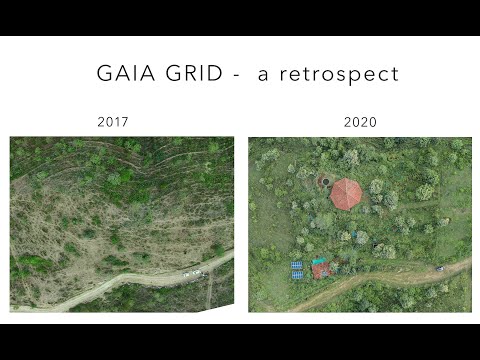
▶ Gaia Grid: documentary
Gaia Grid · fundraiser · budget & infrastructure
A one acre fully crowdfunded pioneer in the global land art movement. Budget & infrastructure

⟡ donate
Every rupee goes directly to the land.
Capital estimate · land & built infrastructure · crowdfunded expansion 2026–27
| Line item | Amount (₹) |
|---|---|
| Greenhouse / Drying / Processing Space | ₹ 10,00,000 |
| Community Kitchen | ₹ 8,00,000 |
| Tool Shed | ₹ 5,00,000 |
| Category subtotal | ₹ 23,00,000 |
| Line item | Amount (₹) |
|---|---|
| Irrigation – Sprinklers & Fire Proofing | ₹ 1,00,000 |
| Category subtotal | ₹ 1,00,000 |
| Line item | Amount (₹) |
|---|---|
| Storage Cabinets for Tool Shed | ₹ 50,000 |
| Seed Bank | ₹ 80,000 |
| Category subtotal | ₹ 1,30,000 |
| Line item | Amount (₹) |
|---|---|
| Tools (professional-grade pickaxe, crowbars) | ₹ 30,000 |
| Category subtotal | ₹ 30,000 |
| Line item | Amount (₹) |
|---|---|
| A/V Equipment (events, workshops, documentation, field visits) | ₹ 2,00,000 |
| Category subtotal | ₹ 2,00,000 |
| Line item | Amount (₹) |
|---|---|
| Solar Power Setup (lighting + device charging) | ₹ 1,50,000 |
| Biogas System (kitchen waste to cooking fuel) | ₹ 1,50,000 |
| Category subtotal | ₹ 3,00,000 |
| Line item | Amount (₹) |
|---|---|
| Fence Repair (perimeter & security) | ₹ 1,00,000 |
| Outdoor Seating (benches, shade structure) | ₹ 40,000 |
| Category subtotal | ₹ 1,40,000 |
Films & talks
A short film on the vision and work at Gaia Grid.
A deep dive into the philosophy and journey.

Harsh speaks about change, and how not to be it.

Articles & features
"Sustainability comes first", an early feature on the project.
"Often, hilltop areas are rocky and the soil is not very fertile because the rainwater has washed away the top soil. I'm trying to show that this place can support all our needs of food, water and shelter in a sustainable manner."
"One Man's Attempt to Create a Self-Sustaining Community."
"I woke up one morning knowing that I needed to quit the job I was pursuing. I had no idea then what I would do. All I knew with certainty was that I must quit."
"Could this regenerative Kerala homestead signal a truly sustainable off-the-grid future?"
"My canvas is the land itself, and my medium consists of soil, seeds, and time. Every day, I dig into this canvas, planting seeds and trees. I've spent days standing in the same spot, envisioning how this landscape might transform over the years, building this living artwork in my mind."
"Fool on the hill", an intimate Q&A with Harsh.
"I am Harsh, and I am growing a mini forest. I use the tree planting as a front for changing peoples hearts and minds. They come to plant trees and work on the land, but they often leave with new life goals and only a dash of nihilism."
Gaia Grid is a one acre food forest and land artwork in the Kadambara Hills of Kerala. The project is fully crowdfunded and more than 900 volunteers have helped build it. We live on this land for most of the year, often alone for months at a time.
The vision is to create India's first land art movement focused on ecological regeneration, for the global audience. Everything is open source. A small farmer or a tribal family can copy the methods. The work is slow, patient, and grounded in daily attention to the land.
We have dug 1,500 percolation pits by hand. Groundwater rose from 550 feet to 250 feet, a gain of 300 feet. Over 1,000 native trees have been planted. Soil organic carbon increased from near zero to between 0.9 and 1.18 percent. The soil colour changed from pale sand to dark brown when wet. We have built 200 metres of contour bunds, a dormitory, a kitchen, compost toilets, and vernacular shelters from local stone and upcycled roof tiles and timber.
The project has been fully crowdfunded since 2016. The only institutional grant we received was $2,500 from The Pollination Project, which paid for five hundred saplings, part of the volunteer dormitory, and a basic irrigation system. Every other rupee has come from small individual donations.
The Irula tribe are the primary stakeholders. Irula Akkas share their knowledge of local plants, forest management, and vernacular building. We document this knowledge and share it back to the greater community. The volunteers, more than 900 of them, are co-stewards. We are the stewards of the land.
The land has a dormitory that doubles as a yoga shala, a shared kitchen, compost toilets, and several vernacular shelters. Volunteers spend their days digging new percolation pits, planting trees, maintaining bunds, cooking together, and learning about conservation and their inner landscape. Gaia Grid is off the grid and fully resilient in water and electricity. The minimum stay is two days, and some people stay for months. There is no luxury, just physical work and the silence of the forest (not during monsoon though).
Over the next five years, the project will deepen what already exists. We have two big picture goals. The first is to build farm capacity by adding a tool shed, a seed bank, fire protection sprinklers, a greenhouse, and more living spaces for volunteers. The second is to host five hundred volunteers every year. We also plan to spend time in neighbouring villages listening to residents, documenting the village festivals, and we are slowly writing a book about the ten years of this experiment.